Key Takeaways
- Attendance tracking monitors employee presence, punctuality, and total work hours.
- Time tracking measures how those hours are spent across tasks and activities.
- Attendance tracking is essential for payroll processing and labour law compliance.
- Time tracking is essential for productivity monitoring and resource allocation.
- Most Canadian employers need both — on the same platform.
- Real-time attendance tracking minimizes time theft and payroll errors.
- Automated systems improve payroll processing accuracy significantly.
Understanding the difference between time tracking vs attendance tracking helps Canadian employers choose the right tools for their team. Attendance tracking records when employees start and stop work. Time tracking records what they do during those hours. They are related but distinct. One answers “Is the employee here?” The other answers “What are they working on?” This guide explains both, compares their key features, and helps you decide which — or both — your organisation needs.
What Is Attendance Tracking?
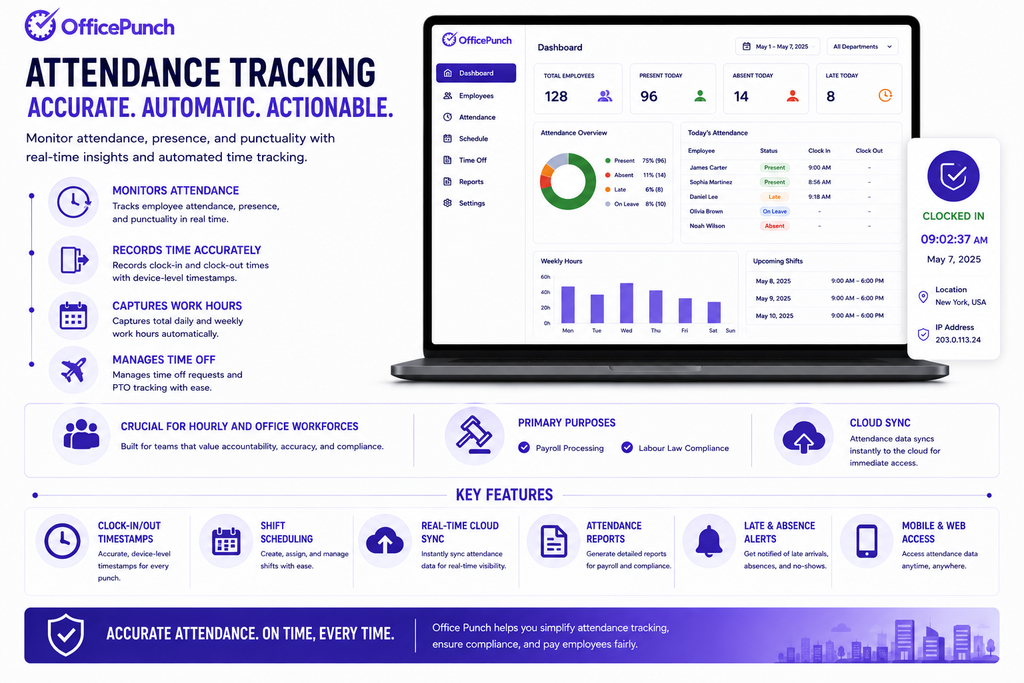
Attendance tracking monitors employee attendance, presence, and punctuality. It records clock-in and clock-out times. It captures total daily and weekly work hours. It manages time off requests and PTO tracking.
Attendance tracking is crucial for hourly-wage workforces and traditional office environments. Primary purposes include payroll processing and labour law compliance. Attendance data syncs instantly to the cloud for immediate access. Key features include clock-in/out timestamps and shift scheduling.
What Attendance Tracking Records
- Employee clock-in and clock-out times
- Total hours worked per shift and pay period
- Break durations and meal periods
- Approved time off and PTO balances
- Absence patterns and late arrivals
Attendance tracking is structural around shifts and total daily presence. It tells employers whether employees were where they were supposed to be.
What Is Employee Time Tracking?
Employee time tracking goes deeper than attendance. It records how working hours are spent — across tasks, categories, or activities. It logs hours spent on distinct work types. It identifies where time is going within a shift.
Time tracking software provides real-time attendance data for managers. Time tracking can identify inefficiencies in processes or tasks. Automated time tracking reduces manual errors in payroll processing.
What Time Tracking Records
- Hours spent on specific work types or tasks
- Active versus idle time throughout the shift
- App and website usage during work hours
- Productivity patterns across the team
Time tracking tools help monitor productivity and labor costs. They transform attendance data into actionable productivity insights.
Time Tracking vs Attendance Tracking: The Core Difference
| Feature | Attendance Tracking | Time Tracking |
|---|---|---|
| Primary question | Was the employee present? | What did the employee do? |
| Data focus | Clock-in, clock-out, total hours | Activity, productivity, task time |
| Main use | Payroll, compliance | Productivity monitoring |
| Granularity | Daily and weekly totals | Minute-by-minute or task-level |
| Best for | Hourly workers, office teams | Knowledge workers, remote teams |
Both serve Canadian employers. Both support labour law compliance. They are complementary, not competing.
When Attendance Tracking Is What You Need
Start tracking attendance when your priority is payroll accuracy and compliance. Attendance tracking software is the right primary tool when:
- You pay employees hourly and need verified work hours for payroll
- You manage shift scheduling across multiple locations
- Teams work at job sites, field locations, or in schools and after school programs
- You need to track hours for labour law compliance
- You want to eliminate manual paperwork and reduce administrative overhead
Geofencing ensures employees clock in only at approved locations. Real-time attendance tracking minimizes time theft and buddy punching.
When Employee Time Tracking Is What You Need
Employee time tracking is the right primary tool when your priority is productivity visibility. Use it when:
- You need to understand how employees spend their work hours
- You manage remote employees with no direct observation
- You want to measure productivity patterns across distributed teams
- You need to reduce administrative tasks
Automated time tracking reduces manual errors in payroll processing. It monitors employee work hours at the activity level — not just the attendance level.
When You Need Both
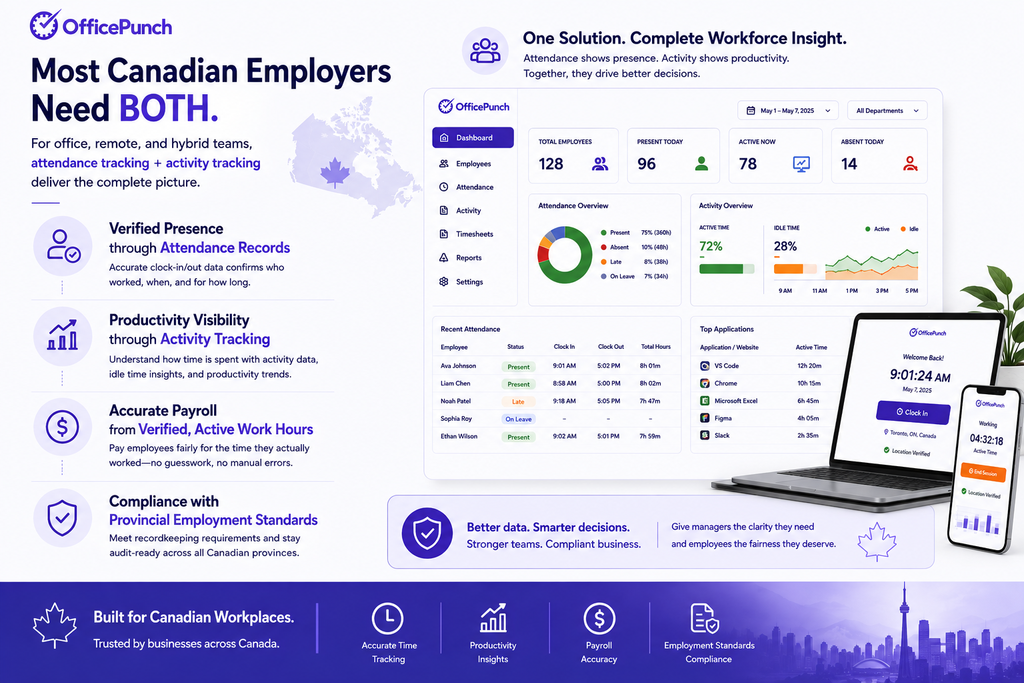
Most Canadian employers managing office teams, remote teams, or hybrid workforces need both. The combination gives employers:
- Verified presence through attendance records
- Productivity visibility through activity tracking
- Accurate payroll from verified, active work hours
- Compliance with provincial employment standards
Time and attendance software automates employee work hour tracking on one system. Managing both through one platform eliminates the gaps that separate systems create.
Key Features to Compare
Attendance Tracking Software Features
- Auto clock-in and clock-out (triggered on system startup)
- Idle time auto clock-out
- Shift scheduling and shift management
- PTO tracking and time off requests
- Geo-location restrictions for approved clock-in locations
- IP-based access controls
- Detailed reports on attendance records
- Timesheet management and approval workflows
- Reporting tools for labour law compliance
Geolocation and biometric verification enhance attendance accuracy. Automated calculations reduce manual paperwork and save time.
Employee Time Tracking Features
- Active versus idle time monitoring
- App and website usage tracking
- Productivity monitoring and trend analysis
- Screenshot-based proof of work
- Real time attendance dashboards
- Advanced reporting for managers
Time tracking software provides real-time attendance data. Some platforms offer mobile app access for employees to track attendance from various locations — check your specific platform for mobile availability.
Payroll Processing and Compliance
Both attendance tracking and time tracking support payroll processing. Accurate attendance records feed into wage calculations. Accurate time data supports overtime compliance.
Canadian employers must meet provincial record-keeping requirements. Ontario: 3 years. British Columbia: 4 years. Quebec: 3 years (ALS) / 6 years (CRA). Alberta: 3 years. See canada.ca for federal requirements. Integration with payroll systems streamlines wage calculations.
Data Security and Privacy in Canada
Both systems collect employee data. Data security is a compliance requirement — not just best practice. Canadian employers are subject to PIPEDA federally. British Columbia, Alberta, and Quebec have provincial equivalents.
Any attendance or time tracking system must:
- Store employee data with encryption and access controls
- Disclose monitoring practices to employees before deployment
- Limit data collection to what is necessary for the stated purpose
See the Office of the Privacy Commissioner of Canada for PIPEDA guidance.
Why Office Punch Is the Right Answer to Both Questions
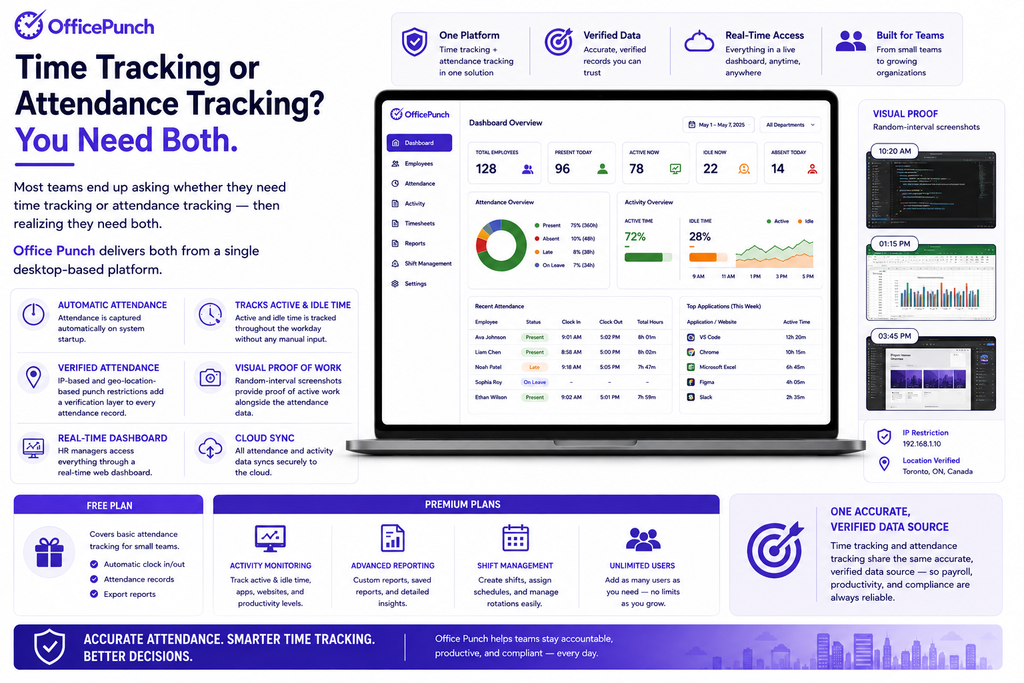
Most teams end up asking whether they need time tracking or attendance tracking — then realizing they need both. Office Punch delivers both from a single desktop-based platform. Attendance is captured automatically on system startup. Active and idle time is tracked throughout the workday without any manual input.
IP-based and geo-location-based punch restrictions give attendance records a verification layer. Random-interval screenshots provide proof of active work alongside the attendance data. HR managers access everything through a real-time web dashboard. The free plan covers basic attendance. Premium plans add activity monitoring, advanced reporting, shift management, and unlimited users — so time tracking and attendance tracking share the same accurate, verified data source.
Need accurate attendance data and productivity insights for your Canadian team? Book a demo with Office Punch. See how one platform covers time tracking and attendance tracking — without managing two separate systems.
Frequently Asked Questions
What is the difference between time tracking and attendance tracking?
Attendance tracking records when employees clock in and out and their total work hours. It answers whether an employee was present. Time tracking records how those hours were spent — on which tasks, with what productivity. It answers what the employee did during their shift. Most Canadian employers need both: attendance tracking for payroll and compliance, and time tracking for productivity visibility.
Which attendance tracking software works best for Canadian employers?
The best attendance tracking software for Canadian employers captures clock-in and clock-out times automatically, supports geo-location and IP-based restrictions, and stores data securely under PIPEDA. Look for shift scheduling, PTO tracking, and time off requests on one platform. Office Punch covers all of these with automatic clock-in on system startup and a real-time web dashboard for admins.
How does employee time tracking improve accuracy?
Employee time tracking improves accuracy by automating the capture of work hours. It removes reliance on manual tracking and self-reported timesheets. Active and idle time are recorded based on actual device activity — not memory or estimation. This produces more accurate attendance data for payroll, more defensible records for compliance, and more actionable productivity insights for managers. Automated systems improve payroll processing accuracy compared to manual methods.
How do I track hours for remote employees accurately?
Track hours for remote employees using attendance software that captures clock-in times automatically and monitors active work through desktop activity tracking. Geo-location restrictions confirm approved work locations. Idle time detection flags inactivity during paid hours. Together, these features give managers accurate employee time records without requiring physical oversight.
What data security obligations apply to attendance tracking in Canada?
Canadian employers collecting attendance data must comply with PIPEDA federally and equivalent provincial privacy laws in BC, Alberta, and Quebec. They must disclose monitoring practices before deployment, limit data collection to what is necessary, and store employee data securely. Ontario employers with 25 or more employees must maintain a written electronic monitoring policy under the Working for Workers Act, 2022.