Key Takeaways
- Remote work productivity can be measured without monitoring every click and keystroke.
- Outcome-based metrics — output quality, engagement, retention — are stronger signals than surveillance data.
- Statistics Canada reports 17.4% of Canadians work mostly from home as of May 2025.
- Flexibility boosts productivity and employee commitment across hybrid and remote teams.
- Employees who feel supported are significantly more likely to give extra effort.
- Transparent attendance tracking is not surveillance — it is visible, disclosed, and employee-accessible.
- The best remote work productivity metrics protect employee well-being while giving managers actionable data.
Measuring remote work productivity is one of the biggest challenges facing Canadian managers today. The instinct is to monitor — to track every click, every idle moment, every website visited. But surveillance is not the same as measurement. The most meaningful signals come from outcomes, engagement, and culture — not from watching. This guide covers the metrics that show whether your remote or hybrid team is performing, without invasive monitoring.
Why Surveillance Fails as a Productivity Metric
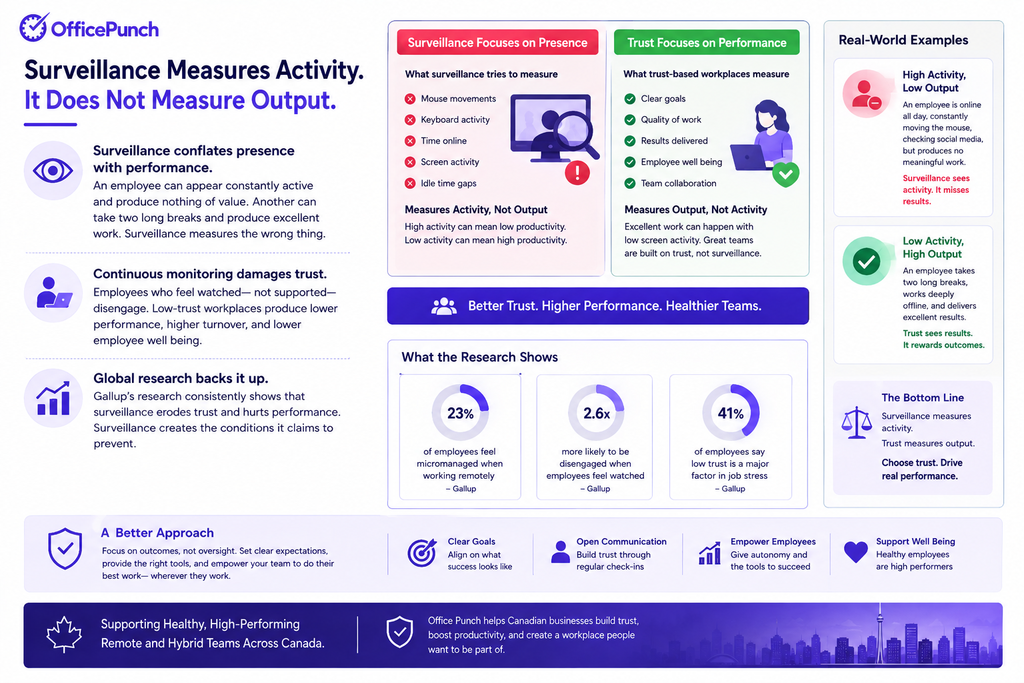
Surveillance measures activity. It does not measure output. An employee can appear constantly active and produce nothing of value. Another can take two long breaks and produce excellent work. Surveillance conflates presence with performance. It measures the wrong thing.
Continuous monitoring also damages the trust that remote work depends on. Employees who feel watched — not supported — disengage. Low-trust workplaces produce lower performance, higher turnover, and lower employee well being. Global research from Gallup consistently supports this. Surveillance creates the conditions it claims to prevent.
What Remote Work Productivity Actually Looks Like
Remote work productivity is not about hours in a browser window. It is about whether employees are meeting goals, maintaining quality, and sustaining performance over time.
Workforce research consistently links high employee engagement to stronger operational outcomes. CPHR Canada and global analysts share this finding across industries. Employees who feel supported are significantly more likely to go the extra mile. Companies with engaged employees consistently outperform those without.
These are the signals worth measuring.
Metric 1: Output Quality and Goal Completion
The most direct productivity metric is whether employees are completing their work to the required standard. Employee well being also shows up here — sustained quality output depends on sustainable workloads. Set clear task priorities to improve work efficiency. Stick to a consistent daily routine to enhance productivity. Use a task manager to track progress on daily priorities.
Measure:
- Tasks completed against agreed targets
- Quality of deliverables reviewed by managers or peers
- Deadlines met versus missed over a rolling period
- Error rates or rework required
These metrics tell you what surveillance never can: whether the work is actually good.
Metric 2: Employee Engagement Scores
Employee engagement is one of the strongest predictors of remote work productivity. Companies with high engagement show significant performance improvement. Engaged remote employees consistently outperform disengaged office workers.
Schedule regular check ins to monitor engagement. Ask direct questions. Use short pulse surveys — monthly or quarterly. Track engagement scores over time. Declining scores are an early signal of productivity problems. Rising scores predict sustained high performance.
According to Statistics Canada, 17.4% of Canadians worked mostly from home as of May 2025. Structured engagement measurement has never been more important for Canadian employers managing distributed teams.
Metric 3: Retention Rates
Turnover is one of the most expensive productivity signals a business can ignore. High turnover signals something is wrong — with culture, management, workload, or the work environment.
Track:
- Voluntary turnover rates by team and role
- Exit interview themes for remote versus in-office staff
- Tenure trends among fully remote workers
Retention rates reveal whether the working model is working — the clearest signal available.
Metric 4: Employee Well-Being Indicators
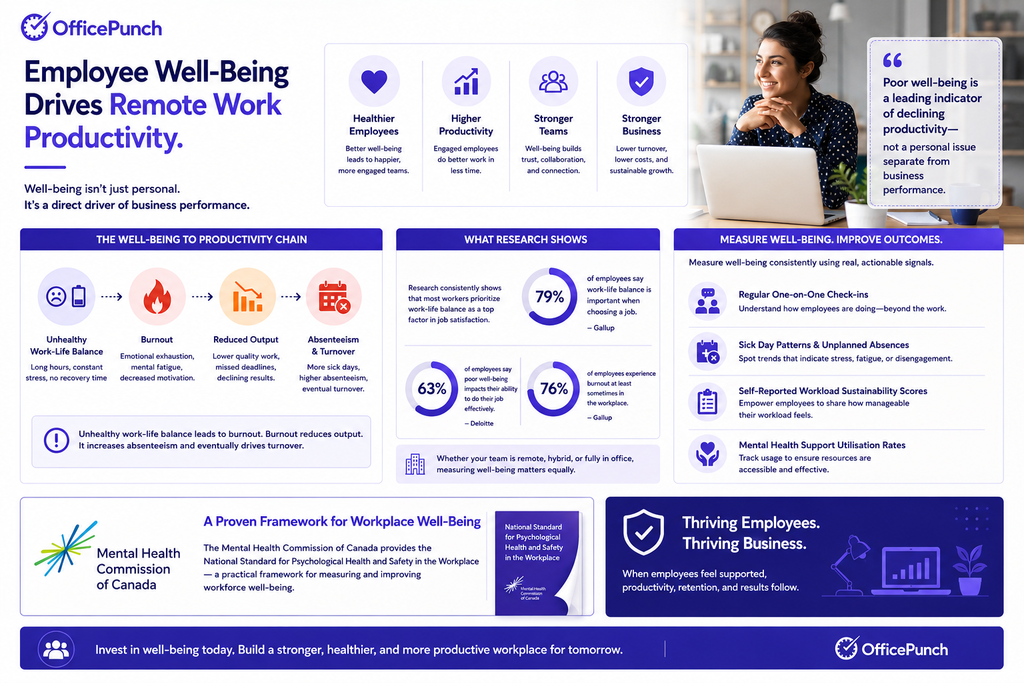
Employee well-being directly affects remote work productivity. Unhealthy work life balance leads to burnout. Burnout reduces output. It increases absenteeism and eventually drives turnover.
Research consistently shows that most workers prioritize work life balance as a top factor in job satisfaction. Poor well-being is a leading indicator of declining productivity — not a personal issue separate from business performance.
Whether in hybrid and remote work arrangements or fully in office, well-being measurement matters equally. Measure it through:
- Regular one-on-one check-ins
- Sick day patterns and unplanned absences
- Self-reported workload sustainability scores
- Mental health support utilisation rates
The Mental Health Commission of Canada provides the National Standard for Psychological Health and Safety in the Workplace — a practical framework for measuring and improving workforce well-being.
Metric 5: Communication Quality and Response Patterns
In remote teams, communication is infrastructure. It replaces the in person spontaneous collaboration that office space provides naturally. Poor communication generates delays. It creates rework. It breeds disengagement.
Measure:
- Response time norms within the team
- Meeting attendance and participation rates
- Quality of written communication in shared documents
- Whether teams are maintaining alignment without requiring someone’s desk nearby
Build social contact into remote work to enhance connection. Regular check ins should serve as quality signals, not surveillance sessions.
Hybrid vs Remote: Do Productivity Metrics Differ?
Hybrid Work Model
In a hybrid work model, employees split time between office and home. Hybrid teams need metrics that account for both environments. In person collaboration days produce different outputs than solo remote days. Measure accordingly.
Fully Remote Teams
Fully remote workers have no in office reference point. Their productivity metrics must be entirely outcome-based. Engagement, output quality, retention, and well-being are the primary signals. Time-at-desk metrics are meaningless without physical context.
Hybrid Workplace Consistency
In hybrid work arrangements, consistency matters. In office staff and remote employees should be measured by the same standards. Different standards based on physical presence create resentment and undermine company culture.
What Transparent Tracking Looks Like
Transparent attendance tracking is not surveillance. The difference is disclosure and employee access.
Surveillance is covert. It collects data employees do not know about. It is used against them without their knowledge.
Transparent tracking discloses what is monitored, why, and how data is used. Employees can see their own records. The purpose is workforce visibility — not control.
This distinction matters legally in Canada. Under PIPEDA and Ontario’s Working for Workers Act, 2022 (S.O. 2022, c. 7), electronic monitoring must be disclosed. Employers must explain what is tracked and why.
Why Office Punch Measures What Matters — Without Surveillance
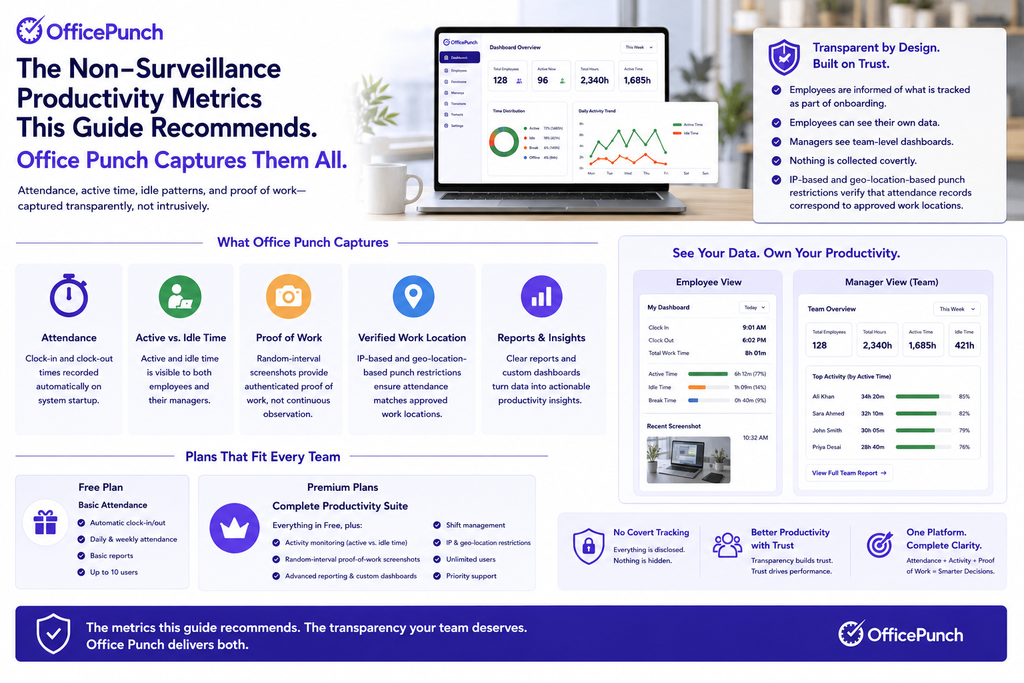
The metrics this guide recommends — attendance, active time, idle patterns, proof of work — are exactly what Office Punch captures. Clock-in and clock-out times are recorded automatically on system startup. Active versus idle time is visible to both employees and their managers. Random-interval screenshots provide authenticated proof of work, not continuous observation.
Employees are informed of what is tracked as part of onboarding. They can see their own data. Managers see team-level dashboards. Nothing is collected covertly. IP-based and geo-location-based punch restrictions verify that attendance records correspond to approved work locations.
The free plan covers basic attendance. Premium plans add activity monitoring, proof-of-work screenshots, advanced reporting, and custom productivity dashboards — the non-surveillance productivity metrics this guide recommends, delivered through one transparent platform.
Want to measure remote work productivity without surveillance? Book a demo with Office Punch. See how Canadian employers measure what matters — attendance, activity, and engagement — without monitoring what doesn’t.
Frequently Asked Questions
What are the best remote work productivity metrics that don’t involve surveillance?
The strongest remote work productivity metrics are outcome-based: task completion rates, output quality, engagement scores, retention rates, and well-being indicators. These show whether remote employees are performing sustainably — not just whether they are online. Schedule regular check ins for qualitative signals. Combine output data with engagement surveys for a complete picture without invasive monitoring.
How does hybrid work affect productivity measurement?
Hybrid work complicates productivity measurement because employees alternate environments. Measure hybrid and fully remote employees against the same output-based standards. Avoid physical presence as a proxy for productivity. In a hybrid work model, engagement scores, deliverable quality, and retention rates are stronger indicators than attendance patterns.
Is attendance tracking the same as employee surveillance?
No. Attendance tracking records clock-in and clock-out times — with employee knowledge and consent. Surveillance collects data covertly, without employee awareness. Under PIPEDA and Ontario’s Working for Workers Act, 2022, Canadian employers must disclose electronic monitoring. Transparent, disclosed attendance tracking is a legal compliance tool. Covert monitoring without disclosure is a different — and legally riskier — practice.
How does employee well-being affect remote work productivity?
Employee well-being is a direct driver of remote work productivity. Burnout from poor work life balance reduces output, increases absenteeism, and drives turnover. Fully remote workers face particular well-being risks from social isolation and unclear boundaries between work and personal life. Employers who measure well-being through regular check-ins and pulse surveys catch productivity problems early — before disengagement or attrition. The Mental Health Commission of Canada provides standards for psychological health at work.
What does company culture look like for fully remote teams?
Company culture for fully remote teams is built through intentional communication, consistent values, and regular human connection. Maintain alignment through scheduled calls, clear norms, and explicit recognition. Build social contact into remote work to preserve team cohesion. Strong company culture shows in engagement scores, retention rates, and employees going the extra mile.