Under Ontario’s Employment Standards Act, 2000, the three-hour rule requires employers to pay employees a minimum of three hours’ wages when they report for work and are sent home early. The rule is set out in Section 21.2 of the ESA and has been in effect since January 1, 2019. This post covers exactly when the rule applies, how minimum pay is calculated, which employees are exempt, and what a defensible payroll correction looks like. It is written for Ontario employers, HR managers, and payroll administrators who need to apply the rule correctly and document it properly.
Key Takeaways
- The Ontario three-hour rule applies when an employee regularly works more than three hours a day, reports for work, and is sent home early or works fewer than three hours.
- Minimum pay is the greater of the wages actually earned or three hours at the employee’s regular rate of pay.
- The rule applies to full-time, part-time, temporary, salaried, and remote workers covered by the ESA.
- Exceptions include circumstances genuinely beyond the employer’s control, voluntary early departures by the employee, and shifts that regularly run three hours or less.
- Accurate time records are essential: employers who cannot demonstrate that the rule did not apply — or that the correct amount was paid — are exposed in a Ministry of Labour audit.
- Federally regulated industries in Ontario are not covered by the provincial ESA and follow a separate federal regime.

What the Ontario Three-Hour Rule Requires
The three-hour rule is designed to protect employees from unpredictable scheduling and financial losses when sent home early. The core obligation is straightforward: if an employee who regularly works more than three hours a day reports for work and either works fewer than three hours or is sent home before completing three hours, the employer must pay them for at least three hours of work.
The rule applies equally to office-based, remote, and hybrid employees. Remote workers are entitled to minimum call-in pay under the ESA on the same terms as employees who attend a physical workplace. Employers must pay remote workers for at least three hours if they report for work as directed and are then released early.
Who the Three-Hour Rule Covers
The three-hour rule applies to most employees under Ontario’s ESA, including:
- Full-time and part-time employees
- Temporary workers
- Salaried employees
- Remote and hybrid workers
The rule applies to employees who regularly work more than three hours a day. If the employee’s regular shift is three hours or less, the rule does not apply. The rule is also limited to employees who report for work as directed — an employee who chooses not to attend, or who leaves voluntarily before three hours have passed, is not entitled to minimum three-hour pay.
Federally regulated industries — including banking, telecommunications, and interprovincial transportation — are not covered by Ontario’s ESA. Those employees fall under the Canada Labour Code, which contains its own minimum pay provisions.
How Minimum Pay Is Calculated
Minimum pay under the three-hour rule is the greater of two amounts:
- The wages the employee actually earned for the hours worked, or
- Three hours at the employee’s regular rate of pay
The employer pays whichever amount is greater. This applies at the employee’s regular rate, not at the minimum wage rate, unless the employee’s regular rate is the minimum wage.
Vacation pay accrues on wages earned, including on three-hour rule top-up payments, so a payroll correction also requires updating vacation pay accruals accordingly.
When the Three-Hour Rule Does Not Apply
The Ontario three-hour rule contains several genuine exemptions. Because the rule has subtle conditions, businesses frequently misinterpret how and when it applies — and that misreading creates ESA exposure.
Circumstances Beyond the Employer’s Control
The most commonly cited exception is an emergency or circumstance genuinely beyond the employer’s control. If an employer cannot provide work because of a power failure, severe weather, equipment breakdown caused by an external event, or a similar situation outside the employer’s direct control, the three-hour rule is waived. The exemption requires that the situation was not foreseeable and that the employer could not reasonably have prevented or worked around it.
Routine scheduling changes — sending staff home because it is quiet, cutting hours to manage labour costs, or adjusting shifts after the employee has already arrived — do not qualify as circumstances beyond the employer’s control. These are employer decisions and trigger the minimum pay obligation.
Employees Whose Regular Shifts Are Three Hours or Less
Employees regularly working shifts under three hours are exempt from the rule. The exemption is based on the employee’s regular scheduled shift, not on what happened on a particular day. If the employee’s contract or regular schedule shows a shift of three hours or less, the three-hour rule does not apply to that employee even if they are occasionally sent home before completing their shift.
Other Exemptions
Four additional categories of employees are exempt from the three-hour rule under the ESA’s regulations: students employed in a recreational program operated by a registered charity; students employed to instruct or supervise children in a recreational program; students employed at a children’s camp; and resident building superintendents, janitors, or caretakers.
How Employers Misapply the Three-Hour Rule
The most frequent errors occur in three areas: misreading who qualifies, misidentifying what counts as an emergency, and miscalculating the minimum pay amount.
On eligibility, the rule applies only to employees who regularly work more than three hours a day. Applying the rule without checking that threshold risks underpaying or misclassifying exemptions.
On emergencies, the bar for “beyond the employer’s control” is higher than many employers assume. A slow sales day, a last-minute schedule change, or a manager’s decision to cut a shift short does not qualify. The exemption exists for genuine external events only.
On pay calculation, the error is usually calculating three hours at minimum wage rather than the employee’s regular rate. Where the employee’s regular wage exceeds minimum wage — as it often does — this produces an underpayment. The rule requires the greater of actual wages or three hours at the employee’s regular rate. That is the floor.
Correcting a Missed Three-Hour Rule Payment
When a Ministry of Labour claim arises over a missed three-hour rule payment, the employer needs contemporaneous records to demonstrate that the rule did not apply — or that the correct amount was paid.
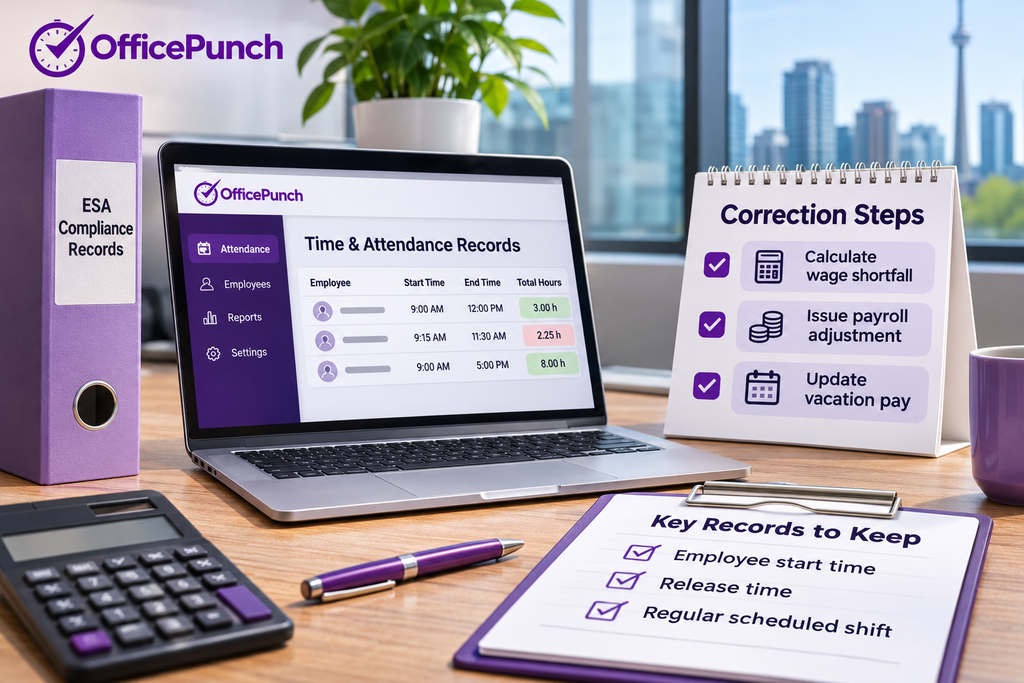
When a missed payment is identified, correcting it requires three steps: calculate the exact wage shortfall (actual pay versus three hours at regular rate); issue a documented payroll adjustment traceable in the employee’s pay record; and update vacation pay accruals on the corrected wages.
If the period is closed, apply the adjustment in the next pay period with clear documentation of what it relates to and why. A verbal acknowledgment or informal cash payment does not hold up in an ESA audit.
The documentation that matters most before a problem arises is accurate daily time records showing when each employee started, when they were released, and their regular scheduled shift. Without that contemporaneous record, there is no factual foundation to demonstrate compliance.
Automated time tracking that records session start and end times from the employee’s computer removes the reconstruction problem. When an ESA question arises, the record is already there, timestamped and machine-generated. Time and attendance records from Office Punch are captured automatically at PC login for Windows and Mac teams, giving managers a defensible daily attendance record without depending on employees to submit manual timesheets.
Frequently Asked Questions
What is the Ontario 3 hour rule?
The Ontario three-hour rule, set out in Section 21.2 of the Employment Standards Act, 2000, requires employers to pay a minimum of three hours’ wages when an employee who regularly works more than three hours a day reports for work and either works fewer than three hours or is sent home early. It has been in effect since January 1, 2019.
What counts as less than three hours under the ESA?
If an employee who regularly works more than three hours a day reports for work and is released before completing three hours, the minimum pay obligation is triggered. The comparison is to the three-hour threshold on that specific day — not to the employee’s total scheduled week.
Does the hour rule apply to on call employees?
Yes, in most cases. If an on call employee reports for work as directed and is sent home after fewer than three hours, the three-hour rule applies. The key condition is that the employee must report as directed. An on call employee who is not called in on a given day has not reported for work and is not entitled to minimum three-hour pay for that day.
Does the three-hour rule apply to salaried employees?
Yes. Salaried employees are entitled to three hours of pay under the rule on the same basis as hourly employees. The calculation uses the equivalent hourly rate derived from the employee’s salary.
What is the minimum pay if an employee is sent home early?
Minimum pay is the greater of the wages actually earned for the hours worked, or three hours at the employee’s regular rate of pay. If the employee earned more by working the actual hours than three hours at their regular rate would produce — which is unusual but possible with commissions — the actual wages take precedence.
Does the Employment Standards Act cover federally regulated industries?
No. Federally regulated industries in Ontario — banking, airlines, telecommunications, and interprovincial trucking — are governed by the Canada Labour Code. The Ontario three-hour rule does not apply; those employees have separate minimum pay provisions under federal employment standards.
Track Work Hours to Support ESA Compliance
Accurate daily time records are the foundation of ESA compliance for the three-hour rule. When a Ministry of Labour question arises, the employer needs contemporaneous records showing scheduled shift length, actual start and end times, and what pay was issued. Manual timesheets filled in after the fact do not meet that standard reliably.
Office Punch records session start and end automatically at PC login for Windows and Mac teams — no manual entry required. Managers see a daily attendance timeline for every employee in a real-time web dashboard and can export records to Excel for any date range. Start with the free plan for up to five users at officepunch.com.