Overtime rules in Canada are not uniform. The threshold, the calculation method, and the record-keeping standard all depend on which province the employee works in and whether their employer is federally or provincially regulated. Across North America, Canadian employers routinely face employment standards complaints where the outcome turns on whether their time records prove what actually happened. This post covers the province-specific rules and the record-keeping standard each jurisdiction expects.
Key takeaways
- Canada has no single national overtime rule; the threshold varies from 40 to 44 hours per week depending on jurisdiction, with some provinces using daily thresholds as well.
- Federally regulated employers under the Canada Labour Code must pay overtime after 8 hours in a day or 40 hours in a week, whichever triggers first.
- Ontario sets the standard overtime threshold at 44 hours per week; BC and Alberta set it at 8 hours per day and 40 hours per week.
- Quebec uses a 40-hour weekly threshold under the Act Respecting Labour Standards and requires written time records for all employees.
- Automated time records — such as those produced by OfficePunch — are more defensible in employment standards proceedings than manual timesheets because they are machine-generated and harder to retroactively alter.
The short answer
Yes, Canadian employers must pay overtime when an employee works beyond the applicable threshold for their jurisdiction. The threshold varies by province and by whether the employment is federally regulated. The employer’s obligation is to prove the hours worked — not the employee’s obligation. If your time records cannot demonstrate exactly how many hours an employee worked in a given pay period, you are exposed in any overtime claim, regardless of whether the employee’s count is accurate.
What the rule actually says
Canada’s overtime rules sit primarily in provincial employment standards legislation and in the Canada Labour Code for federally regulated employers. There is no single federal rule that applies to all Canadian workers.
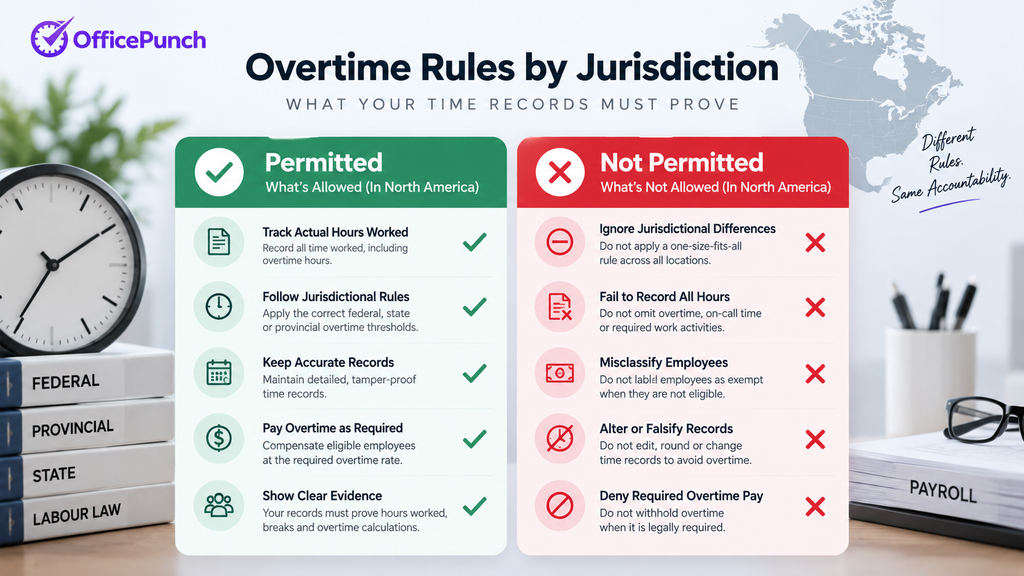
The provision in plain English
The core obligation is: when a non-exempt employee works beyond the applicable daily or weekly threshold, the employer must pay a premium for those additional hours — typically 1.5 times the regular rate, often called time and a half. The premium applies to actual hours worked, not hours scheduled.
The record-keeping corollary is: because the employer bears the burden of proof in an overtime dispute, the employer must maintain time records that are accurate, complete, and accessible. “I don’t have those records” is not a defence in an employment standards proceeding — it shifts the presumption toward the employee’s account of their hours.
What is covered
- All non-exempt hourly employees in any Canadian jurisdiction
- Salaried employees whose salary does not clearly exclude overtime entitlement (salary alone does not waive overtime in most provinces)
- Part-time and casual employees working beyond the applicable threshold in a given day or week
- Remote employees working in a province with overtime protections — the location of work, not the employer’s head office, determines which legislation applies
What is excluded
- Managers and supervisors exercising substantial management authority may be exempt in some jurisdictions, but the exemption is narrowly interpreted by employment standards bodies
- Employees covered by a collective agreement where the agreement provides a different overtime framework
- Certain professions (physicians, lawyers, some professionals) may have different rules under their governing legislation
The exclusion people trip over
Salary does not waive overtime entitlement in Canada. An employee paid a flat monthly salary is still entitled to overtime pay for hours worked beyond the applicable threshold unless a specific statutory exemption applies. Employers who assume salaried employees are automatically exempt from overtime — and who fail to track their hours on that basis — are exposed when an employee files a claim covering years of unpaid overtime.
Why it happens
The US overtime framework under the Fair Labor Standards Act uses a salary-basis test that can exempt higher-paid salaried employees. Canadian employment standards legislation generally does not have an equivalent salary-level exemption. Canadian HR teams who have worked in or with US environments sometimes carry that assumption across the border incorrectly.
How to check your own case
For each salaried employee you believe is overtime-exempt, identify the specific statutory provision in your province that creates the exemption. If you cannot name the provision, the employee is likely not exempt.
Coverage table
Overtime thresholds by jurisdiction:
| Jurisdiction | Governing Legislation | Daily Threshold | Weekly Threshold | Premium Rate |
|---|---|---|---|---|
| Federal (Canada) | Canada Labour Code | 8 hours | 40 hours | 1.5× regular rate |
| Ontario | Employment Standards Act, 2000 | None standard | 44 hours | 1.5× regular rate |
| British Columbia | Employment Standards Act (BC) | 8 hours (12 hours for double time) | 40 hours | 1.5× (2× over 12/day) |
| Alberta | Employment Standards Code | 8 hours | 44 hours | 1.5× regular rate |
| Quebec | Act Respecting Labour Standards | None | 40 hours | 1.5× regular rate |
| Saskatchewan | Saskatchewan Employment Act | 8 hours | 40 hours | 1.5× regular rate |
| Manitoba | Employment Standards Code (MB) | None standard | 40 hours | 1.5× regular rate |
Exceptions and edge cases
Overtime averaging agreements
In BC and Alberta, employers can enter into written averaging agreements that average hours over a defined period — typically one to four weeks — before overtime is calculated. An employee working 50 hours one week and 30 the next would have 40 average hours under a two-week agreement, potentially eliminating the overtime trigger. These agreements must be in writing and meet specific legislative requirements.
Time off in lieu
Ontario, BC, and some other provinces allow paid time off in lieu of overtime pay, provided the employee agrees in writing and the arrangement meets minimum standards. Time off must be provided at 1.5 hours for each overtime hour worked. In some jurisdictions the arrangement must meet formal enforceability standards under the relevant employment standards act.
Federally regulated industries
Federally regulated sectors — banking, telecommunications, interprovincial transportation, broadcasting — follow the Canada Labour Code regardless of where the employee physically works. A Nova Scotia–based call centre employee working for a federally regulated bank follows federal rules (8-hour daily, 40-hour weekly threshold), not Nova Scotia’s provincial rules. This is a common source of error for HR teams whose workforce spans both provincial and federally regulated roles.
Modified work schedules
Alberta allows compressed workweek arrangements — four 10-hour days, for example — without triggering daily overtime, provided the arrangement is documented in writing. Similar provisions exist elsewhere. A verbal agreement is not sufficient in any jurisdiction.
What to do next in North America
Know your jurisdiction
Identify which legislation governs each employment relationship. For provincially incorporated businesses, the governing act is the employment standards legislation of the province where the employee works. For federally regulated businesses, the Canada Labour Code applies regardless of province.
Build your time records to prove what happened
Employment standards adjudicators expect records showing daily start and end times, weekly totals, and overtime hours separately identified. Manual timesheets completed retrospectively are frequently challenged. OfficePunch employee time tracking software auto-records session start and end times from the moment a Windows PC boots — a machine-generated log that is substantially harder to challenge than manual entry.
The overtime rules time sheet records post covers how to structure records to meet the evidentiary standard each province expects. The time tracking screenshots legal monitoring rules resource addresses what is permissible when using monitoring data as evidence in proceedings.
For agencies needing time records tied to client work, the agency time tracking page and the time tracking report overview explain OfficePunch’s reporting options.
Frequently asked questions
What happens if my time records are incomplete during an overtime dispute?
If an employer cannot produce adequate time records, the adjudicator may accept the employee’s account of their hours as more credible by default. The employer bears the burden of proof. Inadequate records typically result in back pay for the claimed overtime hours plus applicable interest.
Do salaried employees get overtime pay in Canada?
Yes, in most cases. Salary does not automatically exempt an employee from overtime entitlement in Canada. The exemption requires the employee to fall into a specific statutory category — typically genuine managers or supervisors. A salaried employee performing non-management work is likely entitled to overtime pay. Track their hours regardless of whether you believe they are exempt.
Can an employee waive their right to overtime pay in Canada?
No. Overtime rights under employment standards legislation cannot be waived by an individual contract. The only mechanisms to vary overtime entitlement are a valid collective agreement, a statutory averaging arrangement, or a compliant time-off-in-lieu arrangement.
How long must employers keep time records in Canada?
Ontario requires records for three years. BC and Alberta require two years. Federal employers under the Canada Labour Code must retain records for three years. Retain records for the longest applicable period given your workforce’s jurisdictions, and longer if records relate to an ongoing dispute.
About OfficePunch
OfficePunch is a Canadian-built Windows desktop monitoring platform serving businesses across North America. The platform auto-records session start and end times from the moment a Windows PC boots and produces exportable time reports that employment standards practitioners recognise. For teams managing employees across multiple Canadian provinces with different overtime thresholds and record-keeping requirements, OfficePunch provides a consistent, centralised attendance record.
Service area
OfficePunch serves employers across North America, including businesses with employees in Ontario, British Columbia, Alberta, Quebec, and federally regulated sectors. The platform supports the record-keeping requirements of each provincial employment standards act and the Canada Labour Code. Major Canadian markets served include Toronto, Vancouver, Calgary, Edmonton, Ottawa, Montreal, and Winnipeg.
Next step
For automated, machine-generated time records that hold up in employment standards proceedings, visit employee time tracking software to explore OfficePunch’s attendance reporting